You Don't Need to Push Harder in Perimenopause. You Need to Move Differently.
For most of your life, the exercise formula was straightforward: work harder, see results. More reps, more miles, more intensity — and your body responded roughly the way you expected it to.
Perimenopause changes that equation, and a lot of women don't find out until they're several months into pushing harder and getting less back for it.
Why the same workout stops giving the same results
As hormones shift during perimenopause, so does how your body responds to exercise. Recovery can take longer. High-intensity training that once left you energised can leave you depleted for days. Muscle mass becomes harder to maintain through the same routines that used to build it. None of this means your body is failing you — it means the rules have changed, and the old formula (harder equals better) stops being reliable.
This is one of the more frustrating parts of perimenopause precisely because it's invisible from the outside. You're doing everything you did before. The results — and how you feel afterward — are different anyway.
Movement, not a workout plan
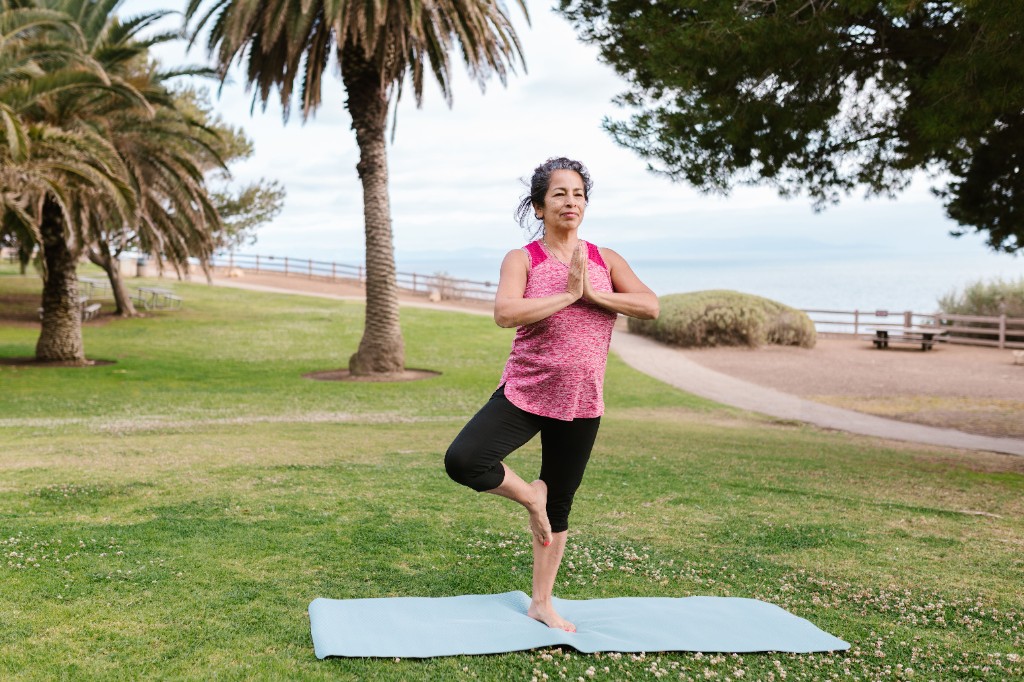
We deliberately call this pillar "Body in Motion" rather than "exercise" or "fitness," because the framing matters. This isn't about a generic training programme with a start and end date. It's about finding the movement that actually works for your body, at your own pace and capacity — which shifts, sometimes week to week, during this stage of life.
For some women that means shifting emphasis toward strength training to protect muscle mass. For others it means paying closer attention to recovery between sessions, or noticing that the intensity that used to feel energising now leaves them wiped out — and adjusting accordingly. There isn't one right answer, because there isn't one perimenopause.
Why generic fitness advice misses the point here
Search "exercise for perimenopause" and you'll find plenty of generic lists — lift weights, walk more, try yoga. All reasonable starting points, none of them specific to you. What's missing is the connection between your movement and everything else that's shifting: your sleep, your stress levels, your energy through the day. A workout that leaves you flattened for 48 hours isn't neutral — it has knock-on effects on how you sleep, how you feel, how much capacity you have left for everything else in your week.
This is where Naomi, our AI, does something a generic fitness plan can't: it looks at how your movement connects to the rest of your Wellness Assessment picture, rather than treating exercise as an isolated box to tick.
At your own pace and capacity — not someone else's
Capacity isn't fixed, and it isn't the same for every woman going through this stage of life. Some weeks you'll have more to give. Some weeks, less. The aim isn't to hit a target regardless of how you're doing — it's to move in a way that works with where you actually are, rather than against it.
That's a genuinely different starting point from most fitness content, which tends to assume a stable baseline you're meant to push past. Perimenopause doesn't offer a stable baseline. Body in Motion is built around that reality, not in spite of it.
Where to start
If movement has started feeling harder to get right — not because you're doing less, but because the same effort isn't landing the way it used to — that's worth exploring through the Wellness Assessment, which looks at how your activity connects to your broader pattern, not just in isolation.
Published 21 Jul 2026
Start with the free Wellness Assessment
A few minutes with Naomi is the start of a picture that's specifically yours — not a generic perimenopause profile, but the pattern showing up for you, right now.
Not sure yet? Try the 2-minute check-in first →
Download the AppSources
- NHS: Physical activity guidelines for adults
- UK Chief Medical Officers' physical activity guidelines
- Royal Osteoporosis Society: Exercise for bones
This article is general information, not medical advice. Please speak to your GP or a qualified health professional before making decisions about your health.
Get the full perimenopause guide — free
Delivered to your inbox. No spam, unsubscribe anytime.